

What does it look like when people begin discovering Jesus through community? When Andrew and his wife moved across the state in 2018, they left behind the kind of support system you don’t fully appreciate until it’s gone. Family dinners became phone calls. Holidays required travel. Everyday inconveniences no longer had built-in help.
“Me and my wife moved out here, and we didn’t have any immediate or extended family,” Andrew explains. “We were kind of off on our own, planting new roots.”
Faith had never been central in his upbringing. There were prayers before dinner and Christmas Eve church services with extended family, but that was about the extent of it. “I didn’t participate in church regularly,” he says. “I didn’t have a group that I studied the Bible with, and I didn’t read it myself.”
He doesn’t describe himself as opposed to Christianity. It simply wasn’t something he engaged with deeply. When he thought about church at all, it was often through scattered impressions of different traditions or rules that felt distant from daily life.
“When I thought about Christianity,” he reflects, “I didn’t really think about Jesus per se.”
That changed because someone invited him to dinner.
An Invitation That Felt Ordinary
A Tend group leader invited Andrew and his wife to come over for a meal and read Scripture together. It wasn’t framed as joining a movement or signing up for a commitment. It was dinner. Conversation. Prayer.
“It wasn’t even presented to me as a group,” Andrew says. “It was just, ‘Do you guys want to come have dinner and do some Scripture reading with us?’”
They said yes because they already enjoyed spending time with the people who invited them. “We jumped at the opportunity,” he says. “We liked hanging out with them and thought it’d be something positive for our life.”
That first night, they showed up to a warm house full of adults and kids. They ate together, family style. Afterwards, kids and adults sat on couches and carpet and opened their Bibles to the Gospel of John. Andrew remembers not knowing where John was in the Bible. “I couldn’t have told you if John was in the New Testament or Old Testament,” he admits. “I didn’t know much about the difference. I was very naive to all of it.”
And yet, what stood out to him wasn’t what he didn’t know, but how the conversation unfolded. “I expected that through the Scripture we read, there’d be a message or a lesson that we’d focus on,” he says. “But what surprised me was just how open the conversation was. There was no right answer to what we were reviewing.”
Instead of being told what the passage meant, the group asked questions. What stands out? What feels challenging? What do you notice about Jesus?
Andrew initially wondered if that openness was situational. “At the time I chalked it up to the kids being present and wanting to engage them,” he says. “But I’ve discovered over time that that’s just something we’ve maintained.”
That openness is not accidental in a Tend group. It reflects a belief that every person at the table bears the image of God and that the Holy Spirit is active in the room. The goal isn’t to eliminate interpretation but to cultivate discernment together. Scripture is read slowly, and people are invited to wrestle honestly.
“Everyone’s interpretation can be different,” Andrew says. “We’re kind of here to just talk about that together.”
That posture created room for him to develop a faith of his own.
Discovering Jesus for the First Time
As the group continued reading through the Gospels, Andrew noticed something subtle but significant.
“I think the easiest explanation is that I started to think about Jesus,” he says. “I don’t know that I could really tell you what I thought about Jesus at all before that.”
Some of the stories he had heard in the past felt distant or difficult to grasp. “If I’m being honest,” he says, “some of the stories just seemed a little fictitious.” But reading the text with others who loved Jesus changed how he engaged with it.
“There’s a lot more to focus on about Jesus,” he explains. “At its base, I think our group focuses on Jesus as the role model and how we can live our lives like Him.”
Over time, Jesus became less abstract and more personal.

“Today, I’d describe Him as my mentor,” Andrew says. “I’d say He’s kind of the bar for which I strive to be. The way I judge my thinking and my actions.”
There wasn’t a dramatic turning point. “It was gradual,” he says. “With each story we read and every discussion we had, it just opened my eyes to what the message was.”
Concepts like repentance, love, and trust in God became clearer through repetition and reflection. “I think some of those simple concepts are kind of what I learned gradually as we continued to read,” he explains.
The shift wasn’t forced. It unfolded over time, through consistent exposure and honest dialogue.
Discovering Jesus in Community
As Andrew’s understanding of Jesus deepened, so did his sense of belonging.
“Being part of this group,” he says, “it’s provided us a community that we didn’t have previously.”
For a couple who had moved away from family, that mattered.
“We rely on them,” he continues. “We can call on them if we need help. We have people we can discuss our hardships with. And when we’re not discussing our hardships, we have people we can talk about faith with now that we didn’t have before.”
The group did not simply offer theological insight. It offered presence. What began as an invitation to dinner slowly became a community that shared life.
Discovering Jesus’s Restoration in Their Neighborhood
As Andrew’s Tend group continued meeting, their conversations began to shape how he and his wife viewed their neighborhood. Scripture’s themes of restoration and stewardship started to feel practical rather than abstract.
“We were looking to expand our outreach,” Andrew explains. “And the idea kind of focused on creation and how, through Jesus’ story in the Bible, we’re encouraged to be part of creation.”
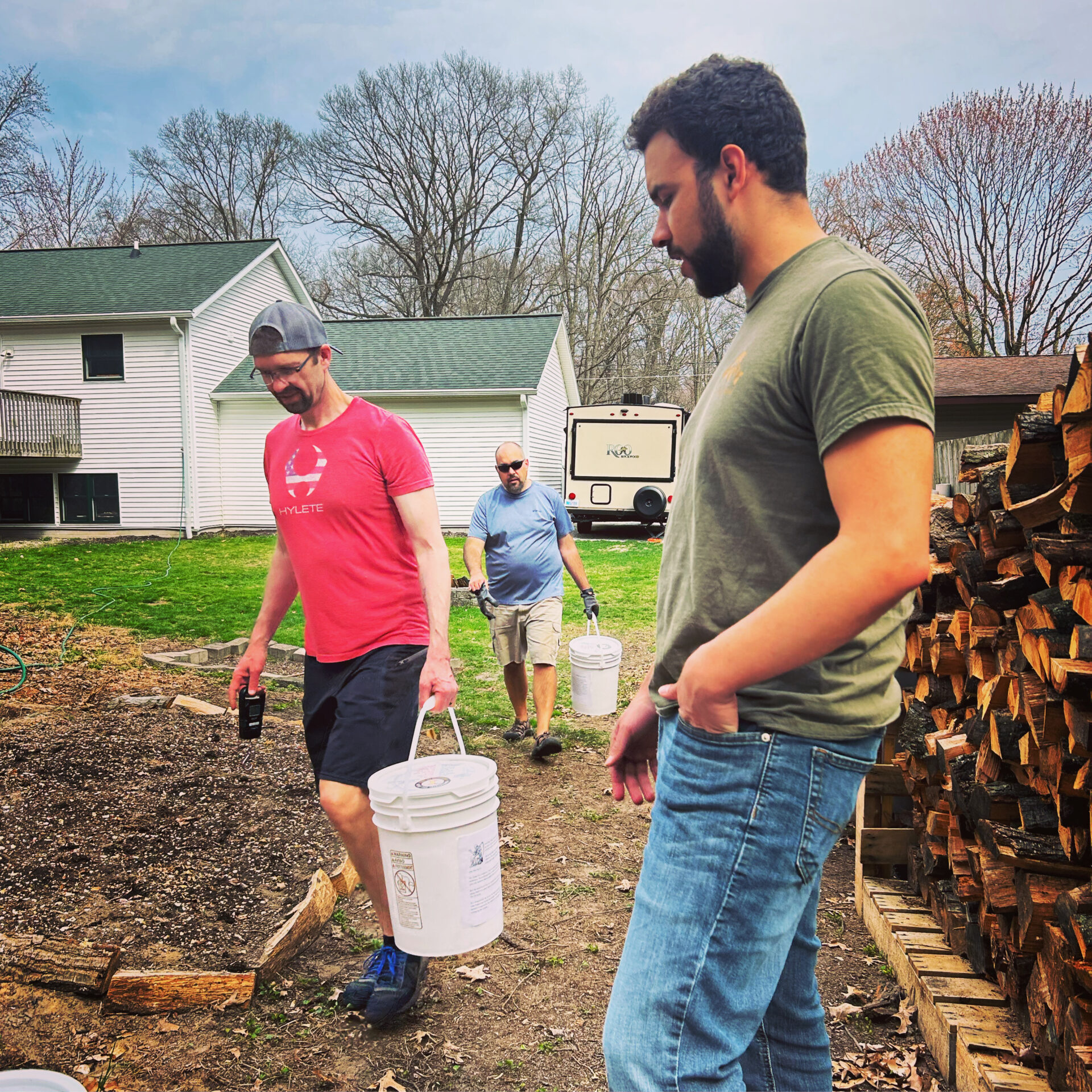
Because many in the group already enjoyed gardening, they had begun participating in the Compost Challenge together, walking their neighborhoods to collect food scraps from neighbors and then gathering to build hot compost piles as a group. Part of the way Andrew got to know the group was by beginning to participate in composting.
But as he got more involved over time, he began imagining what it might look like to start a new hub on his own street. Eventually, he started inviting his neighbors to take part in the same shared effort of turning waste into something life-giving.
“It’s been good,” he says. “Our neighbors who participate are very appreciative of it.”
The project created new rhythms of interaction. More conversations. More familiarity. A reason to connect beyond a quick wave across the driveway.
Andrew is honest that he hasn’t yet had many direct faith conversations with his neighbors through the composting effort. “That’s still kind of lacking in that area,” he says. “But it’s something I hope to maybe cross that line with as we continue.”

Even so, he senses deepened relationships and a responsibility that wasn’t there before to represent Jesus in that place. Not because anyone pressured him, but because his understanding of Jesus has changed how he sees his neighbors.
“At the very least, it’s bringing people in toward something that we believe to be positive for the Earth,” he says. “Something that I think we all are currently being called to do.”
Participation in restoration has become part of his discipleship.
What This Means for Tend Leaders
When asked what he would say to someone unsure about church or Christianity, Andrew doesn’t offer a polished argument. He simply reflects on where he began.
“I kind of started where they might be,” he says. “I don’t really know if I followed anything. I don’t even know what I was.”
His encouragement is straightforward. “If you’re someone that’s curious and you like to learn, we’re not here to form or shape your own opinions. That’s for you to do on your own. We’re just here to explore that with you.”
That is the subtle strength of a Tend group. It doesn’t rush belief. It makes room for it. Tend groups and their leaders trust that God is already at work in the people who show up.
Andrew’s story did not begin with spiritual certainty. It began with an invitation that felt safe enough to accept. Through family meals, intergenerational conversations, consistent presence, open Scripture, and shared participation, Jesus moved from the margins to the center of Andrew’s family.
For leaders wondering whether to start a group or invite a neighbor, Andrew’s story offers inspiration. You do not need to manufacture momentum. You do not need to have every answer prepared. You need a table, a willingness to listen, and the patience to let growth unfold at its natural pace.
Sometimes that is enough.If you’re ready to explore what it might look like to gather a few neighbors and begin, learn more about starting a Tend group and see how simple the first step can be.