Creation runs on giving and receiving, from the microbes in a teaspoon of soil to the chickens on our processing day. Jesus stands at the center of that pattern, from the cross all the way to the fork, and this Thanksgiving is a chance to join the cycle with gratitude.
The Prayer Before the Knives
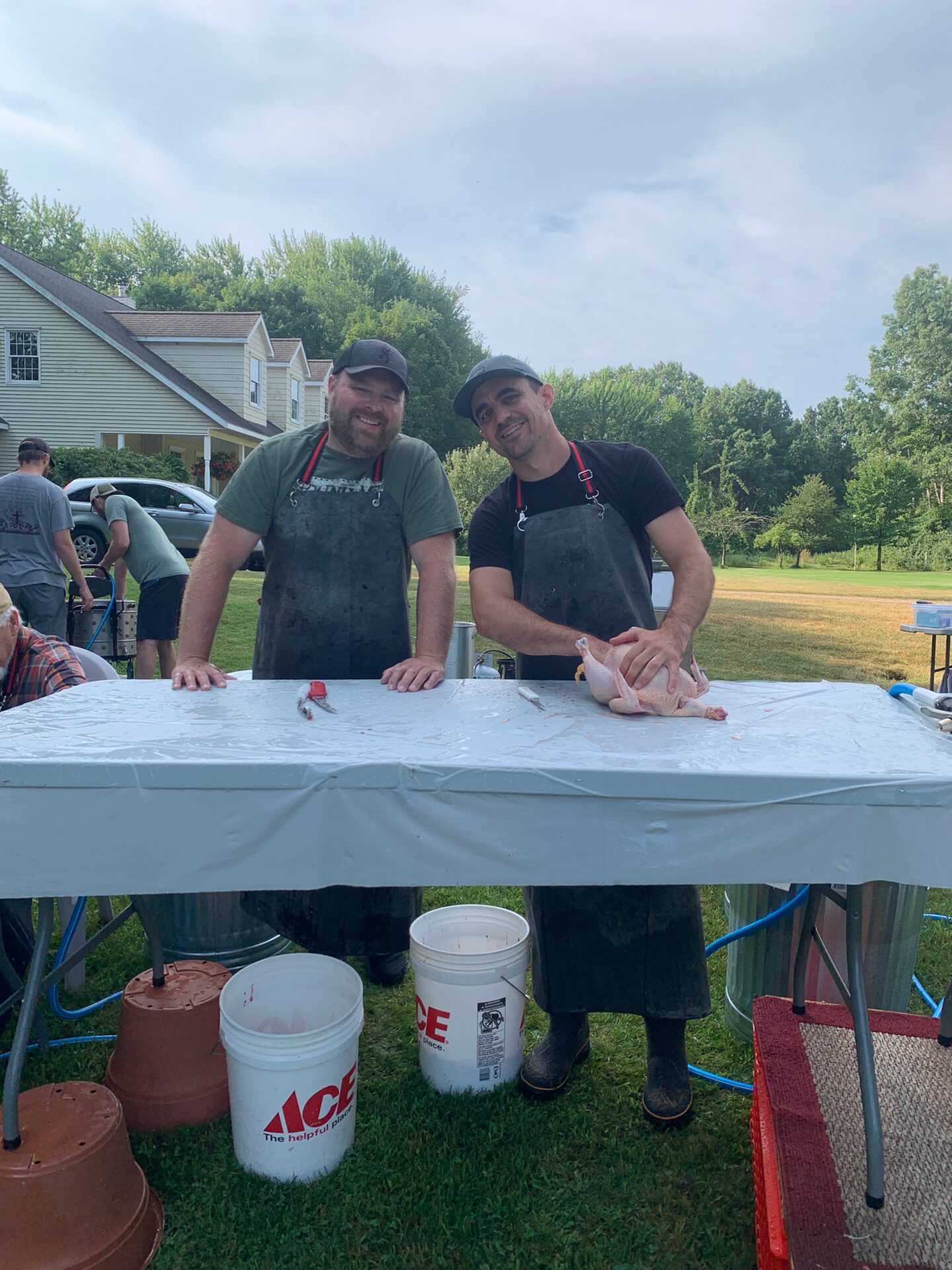
In the warm Michigan summers a few of my friends and I raise chickens on a pasture in Nunica. For meat. They live their best lives for 61 days. But at 7:45am on processing day, eight to ten friends, neighbors, and slightly nervous volunteers show up at our field. We set out folding tables, kill cones, scalders, and pluckers. At 8:00 sharp, after I walk through who’s doing what, we stop and pray. We thank God for the day, for the people, for our customers, and for the chickens whose lives are coming to an end.
When I ask people to join the processing team, I get two kinds of answers. Some get an uncomfortable look on their face and say, “I couldn’t put a knife to a throat. Can I make lunch?” But there are others who light up and say, “Yes! Can I bring my kids?!” Both groups eat chicken, and both want to be helpful. But the parents who bring their kids do so because they want them to know that a meal doesn’t just appear. Something lived, and something died. That cycle of life is sacred, and it’s how God provides plenty for all creation.
What’s Under Your Boots
Dr. Elaine Ingham, who helped popularize the soil food web, notes that a teaspoon of productive soil generally holds 100 million to 1 billion bacteria. UC Davis soil scientists say a gram of soil can easily contain a billion bacterial cells and several miles of fungal filaments. Add the protozoa, nematodes, and earthworms, and a small patch of ground becomes a bustling universe. All day, every day, these organisms are born, eat (each other), and die. The result is highly fertile soil that feeds plants and animals. Scientists themselves admit they still know relatively little about these organisms, and yet every meal we eat depends on them.
That means we’re included in that web. I pull carrots from that soil and eat them. I feed grain to the chickens, and then I eat the chickens. Someday I return to the dust, just as Genesis says, and the worms and fungi take their turn. Even a vegan’s plate runs through this cycle, because something gave itself so they could eat. Everybody gives, and everybody receives.
The Seed, the Table, and the Cross
This pattern didn’t start with soil. Christians have long said it begins in the heart of God. The early church used the Greek word perichoresis for the eternal dance of the Trinity, where Father, Son, and Spirit give and receive in love. You can see it in how Jesus talks. He prays, not my will, but yours. He says He came to do the will of the one who sent Him. And on the night before His death He prays, Father, glorify your Son, that your Son may glorify you. Each gives glory to the other, freely, and it comes back around.
Just before His arrest Jesus says, a grain of wheat stays a single seed unless it falls into the ground and dies. Paul uses the same picture for resurrection: what you sow doesn’t come to life unless it dies. To be clear, death is no hero in this story. Paul calls it the last enemy. But it’s part of God’s plan for creation to keep folding even death back into life.
Notice what Jesus does at the table, too. At His last supper, Jesus gave thanks, broke the bread, and said it was his body given for us. Before He gives, He gives thanks. Gratitude and sacrifice sit side by side in that room. And in Philippians, Paul says Jesus emptied himself and became obedient to death on a cross. That is the deepest giving there is.
But Jesus isn’t Shel Silverstein’s Giving Tree. Jesus also knew how to receive. He asked a Samaritan woman at a well for a drink of water. And when He knelt to wash Peter’s feet, Peter said no. Jesus answered that unless He washed him, Peter would have no part in Him. The cycle can halt in real time. If we’re too proud to receive, too afraid to suffer, or too anxious about scarcity to give, we can choke the abundance God put in the heart of creation.
The first Christians took this personally. Barnabas sold a field and laid the money at the apostles’ feet, and the community, aside from Ananais and Sapphira, shared until no one was in need.
Gratitude Is a Little Bit of Grief
This death-to-life cycle means that our gratitude carries some grief in it, because it means realizing someone else gave up something so I could have this. Maybe that’s why it’s so hard to receive and to give freely. But it’s also why the Lord’s Supper is called Eucharist, which literally means good gift.
Gratitude, then, means jumping into this cycle with our whole lives, willing to sacrifice and grieve the weight of this great gift called life. Leah Penniman of Soul Fire Farm, author of Farming While Black, points to the mycelium beneath our feet, weaving together life across divisions of species and geography. Her work reminds us that reciprocity needs justice. The cost of the cycle can’t keep landing on the same shoulders. We see this in our international work at Plant With Purpose. Partner farmers form Purpose Groups that regenerate land, create new income, and then give some of their income back to their Purpose Group. Purpose Groups also return interest payments to the group instead of an outside lender, so what’s given circulates back to the community. It’s a beautiful picture of the lives that are transformed when people participate fully in the trinitarian giving and receiving intended for us.
From the Cross to the Fork
This is one reason we begin our Tend group gatherings the way we do. When we gather around a table, we pause for gratitude before we eat. It’s a small, sacred practice that reminds us the food in front of us is a gift of life, one that cost something. Someone planted, someone harvested, some creature gave itself, and ultimately we see in Jesus the sacrifice that gives us life. That sacrifice echoes from the cross all the way to the fork.
Nothing about it is fancy. It might take thirty seconds. But do it week after week with the same people, and gratitude stops being an idea and becomes a habit you share.
This Thanksgiving
Thanksgiving is the one meal of the year when nearly all of us pause before eating, so let’s make it count. Before the turkey (or tofurky) hits the table, try this:
- Choose three items on the Thanksgiving table.
- Tell a story about where each item came from: the soil, the plant or creature, and the person who prepared it.
- Thank God out loud together and incorporate those three items into your prayer.
And if you’d like to keep that habit going past November, start a Tend group and make gratitude before meals a regular rhythm.
FAQ
Do I have to farm to practice this?
No. Cooking, gardening, composting, and praying before meals all count.
Isn’t it strange to thank an animal or the soil?
We thank God for the gift and honor the giver. The Haudenosaunee do this daily, and Christians have prayed over meals for two thousand years.
What if I’m the one who always gives and I’m exhausted?
Then the cycle is stuck on your end. Receiving is part of the practice, so let someone carry something for you.
What is a Tend group?
Tend is a small-group discipleship initiative of Plant With Purpose, where neighbors gather for meals, Scripture, and care for the Earth.